The Amsterdam Red-Light District
Controversial? Absolutely.
Louisa, from ‘Husband, Wife Strangers’, was determined to see it.
One aspect of the wonderful city of Amsterdam that courts controversy is the red-light area. In reality, there are three such areas, the biggest and most popular of which is De Wallen (The Walls).
This is where a curious Louisa visited with her husband, Peter, the lead characters in ‘Husband, Wife, Strangers’. But why was she curious, did she have her own particular reasons for wanting to experience it at first hand? Or was she like so many of the casual visitors to the area, the ones who are determined to see it for themselves, but without any intention of paying for the sexual services on offer? You’ll have to read the book to find answers to the first question, but we’ll explore the second in more detail, below.
But in the meantime, here’s a little background on what is generally regarded as the world’s largest red-light district.
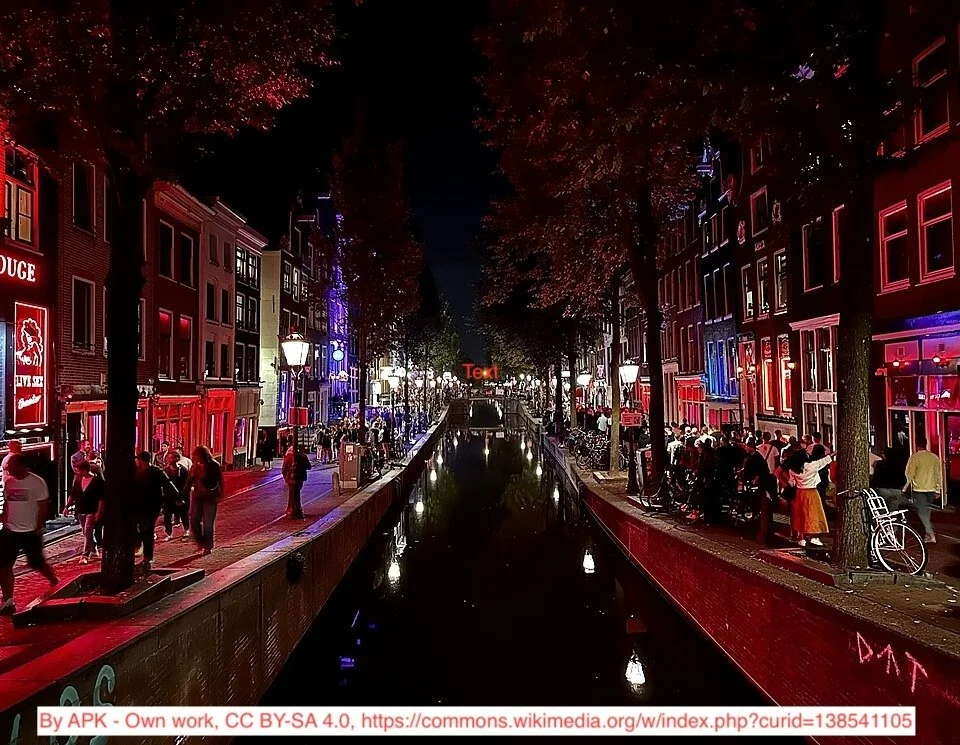
The De Wallen area is the oldest part of Amsterdam, and architecturally rich. Centred at the heart of the concentric rings of canals, the compact area is close to the site of the old port, from where it used to derive much of its custom.
It is now an important tourist destination, visited by the curious as well as those seeking to avail themselves of the temptations on offer. Guided tours for very small groups (maximum four people) are available for those who prefer to be escorted. But this isn’t necessary from a safety point of view, the area is patrolled by police, and visitors are usually well-behaved.
But as you might expect, packs of alcohol and testosterone-fuelled men on stag trips can, and do, present problems, with the smell of vomit and urine never far away.
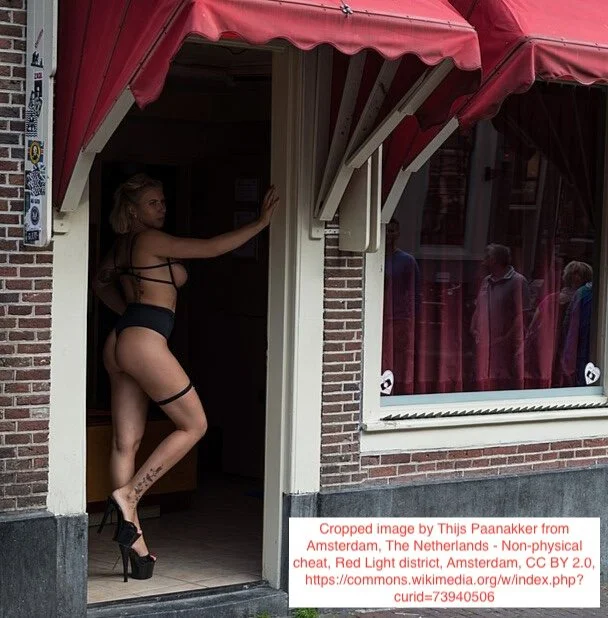
De Wallen hosts over two hundred ‘windows’, where prostitutes typically ply their trade. These windows are rented by the working women, with one window typically hosting two shifts per day. The window (which is usually a glazed door) gives way to a tiny and sparsely furnished room, equipped with a plastic covered bed, a modest bathroom and little else.
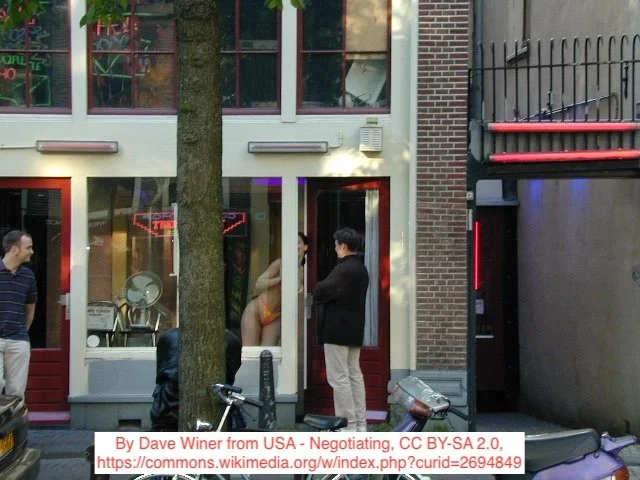
The women studiously ignore the couples holding hands, but tap discreetly on the glass to attract the attention of potential clients. A brief negotiation will then take place through the part opened door before the client is admitted and the curtain closed behind him. A typical visit will be over in minutes, with the man leaving perhaps one hundred Euros poorer. The price depends on the services agreed upon, with pretty much everything representing an ‘extra’ to the cost of simply getting through the door.
A couple of streets feature blue lights above the doors, indicating that this is the workplace a trans-gender woman.
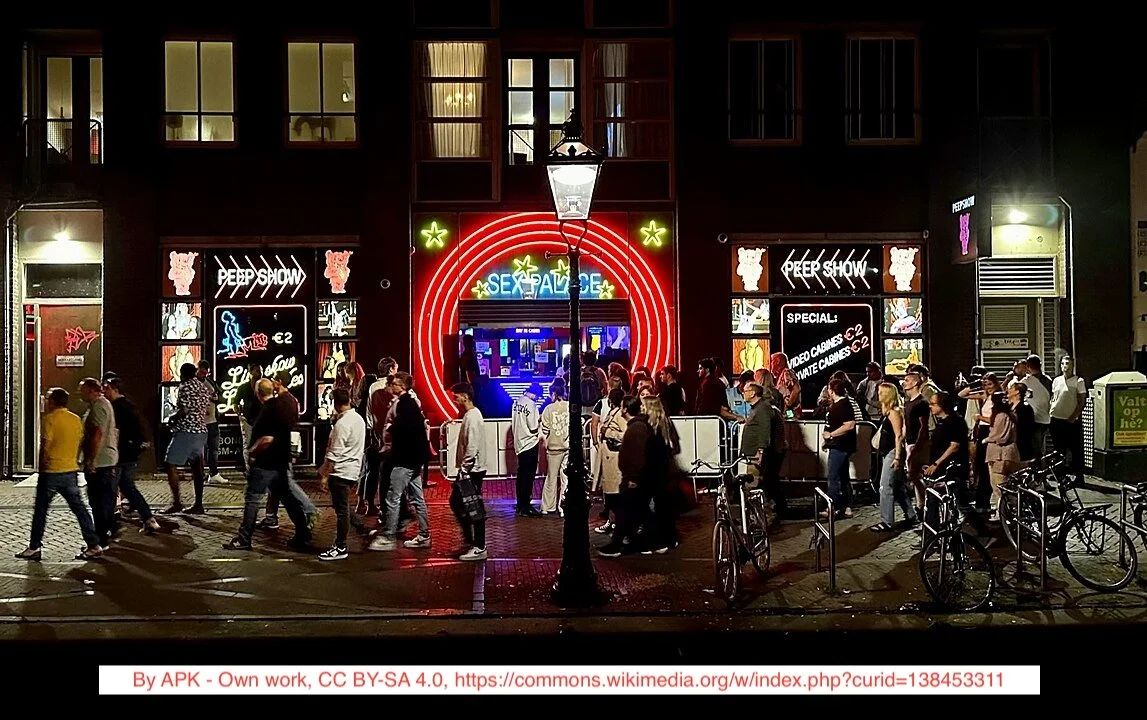
De Wallen is also home to live sex shows, sex museums and shops selling merchandise catering for all manner of sexual preferences. Between them, a multitude of bars and cafés fuel thirsts of a different kind.
The district comes alive after dark, even if some of the windows are occupied during the day, when the stark reality of the scene is more apparent. But as dusk falls, the crowds appear, the alcohol flows, and the smell of marijuana is in in the air. The scene becomes bathed in alluring lights that reflect off the inky canals. Money changes hands quickly.
As for the women, they are working legally, with the majority originating from outside the Netherlands. A residence permit is required, so many come from other parts of Europe. The Netherlands has been listed by the UN as a top destination for people trafficking, with the authorities well aware of the involvement of organised crime in the activities that surround the sex trade.
Many contend that the legal nature of prostitution in the Netherlands helps to keep it where the authorities can monitor and control it. Making it illegal would simply drive it underground, push it further in the direction of criminals, and increase the risk to sex workers.
Others argue that the De Wallen area has got out of hand, and greater restraint and restriction is called for. Proposals for a relocation of the trade to a purpose built ‘erotic centre’ in the south of Amsterdam receive mixed feedback.
A third contingent would outlaw the activity altogether, and pushes for the clean-up of all such red-light areas.
So, back to the motivation. Many of the visitors are there with the intention of availing themselves of the services on offer. They include groups of men on a noisy stag evening, or a solitary and incognito visitor quietly catering to his urges.
But a glance at the crowds also reveals curious solo visitors, loving couples and small parties of friends, the latter exchanging embarrassed smiles and forced humour as they try not to stare. None of these people have any intention of doing anything other than gawping in fascination at the sights before them. So why are they there, from where does their curiosity come from, what urges are compelling them to wander the streets of the red-light district?
Whilst psychologists would no doubt offer more considered theories and explanations, a study of the internet as to the motivation of benign visitors points to a number of recurring themes.
Chief amongst these is the fact that sex is something that is usually conducted in private, and for the most part between emotionally engaged couples. But in De Wallen, it’s right there in front of you, brazen and public. Matters that are typically spoken about in low voices, kept below the surface of normal discourse, are suddenly paraded in full view, hushed activities laid out in stark reality. Sex is instantly divorced from love, the connection between them severed in favour of the instant satisfaction of primal urges. Society teaches us that a relationship precedes sex. De Wallen advances a different perspective.
The casual visitor, their mind conditioned by the norms of society, is at once in awe of the blatant separation. For here, the rules are cast aside in a public display of brutal honesty, the commercialisation of the sex act. At once surreal, titillating and disturbing, but it’s not like a film, for this is actually going on in front of you. And for many people, that feels strange and exciting, even if that excitement is tinged with guilt at the act of seeking it out, and mild shock at witnessing it first-hand.
And so the casual visitor either confronts, or chooses not to confront, their own fascination. They may go on to wonder at the men who pay to enter the tiny rooms for a few minutes of anonymous sex.
Equally, they may wonder about the mindsets and stories of the women who work behind the windows. And fear for the potential for exploitation, crime and the objectification of sex workers. But the women and their visitors are no voyeurs. They are engaged in, and understand the transaction. They focus on its completion, rather than the reasons behind it.
But for those ‘just looking’, the questions about why they are there are perhaps much harder to answer.
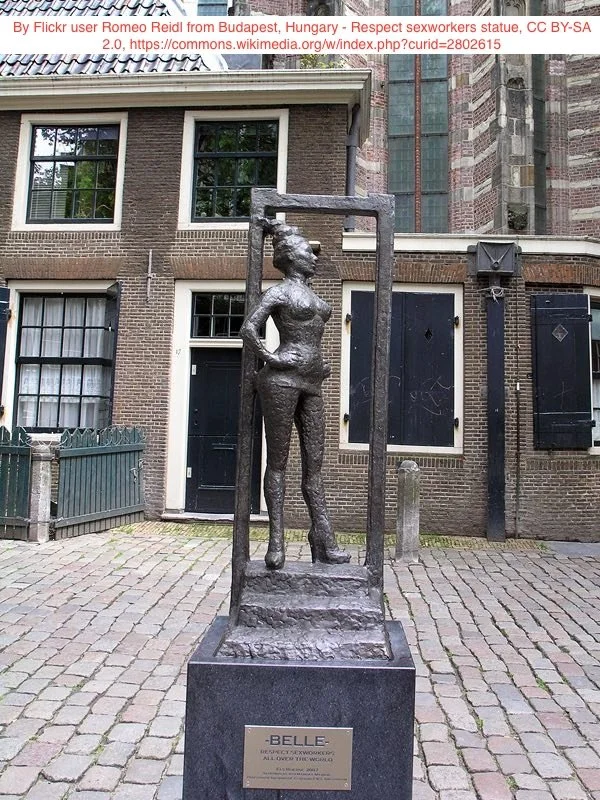
The bronze statue Belle by Els Rijerse, in front of the Oude Kerk (Old Church). The inscription reads ‘Respect sex workers all over the world’.