People we only half know
Why Domestic Suspense hits so close to home
Photo by Cory Mogk on Unsplash
I came across a news story a while back that has never quite left me. In 2005, a 59-year-old company director from Kettering called Melvyn Reed found himself in difficulty. He had just come round from a triple bypass heart operation and, in a moment of poor scheduling, all three of his wives arrived at Leicester Royal Infirmary at the same time.
He had tried to stagger their visits. It didn’t work. The women — one he had married in 1966, another in 1998, a third in 2003 — held a meeting in the car park, and worked out what they all had in common. Reed later turned himself in to police in Wimbledon and pleaded guilty to bigamy. He received a suspended sentence of four months and was ordered to pay £70 in costs.
The thing that stayed with me wasn’t the logistics of the deception — though they are extraordinary. It was trying to imagine what each of those three women felt in that car park. Because every one of them, until that moment, thought she knew exactly who Melvyn Reed was.
That phrase — I thought I knew him — is the one that echoes through every domestic suspense novel ever written. And I’d argue it’s the reason the genre strikes such a nerve. It isn’t really about murder, or mystery, or the mechanics of a clever plot. It’s about the most ordinary and most terrifying thing in the world: the discovery that someone you thought you knew was, in some important respect, a stranger.
When I was working in Amsterdam — living in a rented apartment during the week and returning home to England at the weekend — I was struck by how completely separate my two lives felt. Not because anything was hidden. My wife knew exactly where I was and what I was doing. But, despite the occasional visit, it was hard for her to picture my life.

Photo by mana5280 on Unsplash
She didn’t know my neighbours, couldn’t visualise the streets I walked to work, her sense of the rhythm of my week was a function of what I told her. And I realised that this is true of almost every couple where both partners work. You share a home, a family, a history. But vast portions of each other’s daily lives remain essentially invisible.
Now add secrecy to that invisibility — and everything changes. The domestic suspense novel takes that everyday gap and asks: what if something were living in it? What if the business trip wasn’t quite what it seemed? What if the late night at the office was real, but not for the reason you were told? What if the person sitting across from you at the dinner table, who you’ve shared a bed with for twenty years, had a life you knew nothing about?
The reason these questions unsettle us so deeply is that they’re not entirely hypothetical. We’ve all had the experience — on a smaller scale — of discovering something unexpected about someone we thought we knew well. A friend’s admission that surprises you. A parent’s facade that doesn’t fit the person you grew up knowing. A colleague’s behaviour that makes you reassess everything you thought you understood about them. These moments of revelation are disorienting precisely because they remind us that our knowledge of other people is always partial, always constructed, always, to some degree, a story we’ve told ourselves.
What domestic suspense does — at its best — is to place that ordinary disorientation at the heart of a gripping story, and then lean on it. Hard.
HUSBAND WIFE STRANGERS begins with a marriage that is, on the surface, entirely ordinary. A successful career woman. A husband who works away. A beautiful house. The life they appear to have is the life most people would recognise. But beneath it, something is shifting. And as Louisa begins to look more carefully at the man with whom she’s shared the past twenty years, what she finds doesn’t fit the image she’s been carrying.
I wanted readers to feel, as they followed her, that nagging and very human discomfort of having to revise their understanding of someone they thought they knew. Because I suspect most of us, if we’re honest, have felt something like it. Maybe not on that scale. But the feeling — that vertiginous moment of realising that the person in front of you is more complicated, more opaque, more unknown than you thought — that feeling is universal.
That’s why domestic suspense hits so close to home. It isn’t really set in a fictional world at all. It’s set in ours.
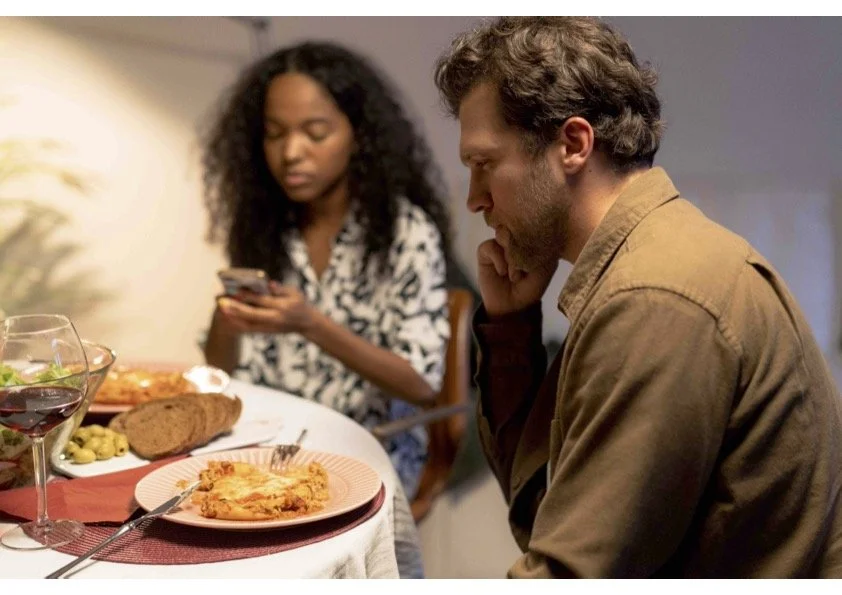
Photo by cottonbro studio on Pexels
Have you ever had that experience — of discovering something about someone close to you that made you reassess everything? I’d be very glad to hear about it, if you feel like sharing. Drop me a line at robbie@robbievale.com.
Source for the opening anecdote: The Guardian